Rigomo Wants to Change How Doctors Learn. Can It Prove Its Courses Change Practice?
The Rigomo co-founder discusses the platform's growth, medical education, AI safety and why registrations and certificates alone cannot prove better clinical outcomes.
 Kunal Mishra
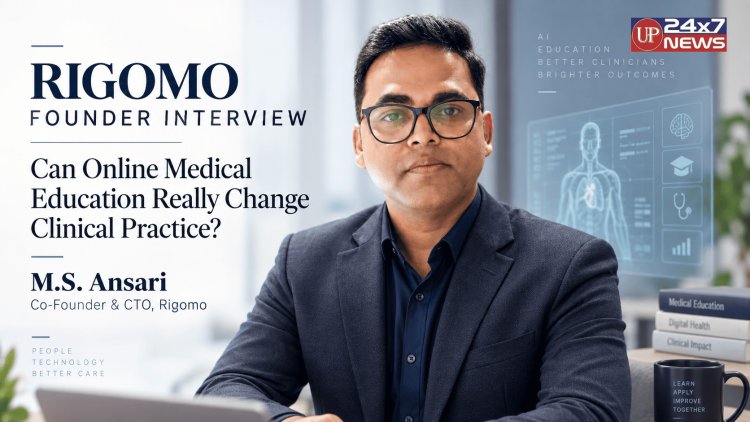
Rigomo Wants to Change How Doctors Learn. Can It Prove Its Courses Change Practice?
Founder M.S. Ansari on 50,000 registered users, AI in medicine, medical education, certificates and the difficult question of whether online learning actually improves patient care
By Kunal Mishra | UP24x7News
New Delhi: India's doctors are not short of medical information. They have textbooks, journals, conferences, clinical guidelines, online lectures and, increasingly, artificial intelligence at their fingertips.
The harder question is what happens after they consume all that information.
Does an online course make a doctor better at making a clinical decision? Does a certificate demonstrate competence? And when a healthcare learning platform claims tens of thousands of users, how many have actually learned something that changed the way they work?
These are uncomfortable questions for the rapidly expanding medical EdTech sector—and ones that Rigomo, an online learning platform for doctors and healthcare professionals, is now confronting as it seeks to expand beyond courses into AI, professional development and healthcare workflows.
In an exclusive interview with UP24x7News, Rigomo Co-Founder and CTO M.S. Ansari argues that the company's real mission is not to put more medical information online, but to narrow the gap between knowledge and action.
But Ansari also makes an unusually direct admission: Rigomo does not yet have longitudinal scientific evidence showing that its courses have independently improved patient outcomes across the platform.
That distinction—between reach and measurable impact—could become one of the biggest tests of Rigomo's next phase.
The problem is not information. It is application.
According to Ansari, Rigomo was created around a simple observation: medical education is often organised around subjects, lectures and examinations, while clinical practice is organised around problems.
A doctor does not necessarily have the luxury of sitting through hours of content before making a decision.
“In an emergency, there may be even less time,” Ansari said, describing the problem Rigomo set out to address.
The platform's approach is therefore built around practical frameworks, cases, workflows and decision-making rather than simply reproducing traditional lectures online.
Accessibility is another part of the company's argument.
A doctor working outside India's major metropolitan centres may not always be able to travel for conferences or expensive training programmes. Online education can remove some of those barriers.
But access is only the first step.
The more difficult question is whether that education works.
‘A certificate by itself does not prove competence’
Ansari is clear that Rigomo does not consider course completion sufficient evidence of professional competence.
He breaks learning into several levels: engagement, knowledge, confidence and, ultimately, behaviour.
The last one is the hardest to measure.
The critical question, he says, is whether a healthcare professional “think[s] or act[s] differently” when a similar situation occurs in practice.
Rigomo currently tracks learning progress, completion, assessments where included, feedback, ratings and repeat engagement.
But Ansari stops short of claiming that these metrics demonstrate improved patient care.
That restraint is important.
In healthcare, an EdTech platform cannot simply point to a high completion rate and conclude that clinical practice has improved.
Rigomo's next step, according to Ansari, is to introduce more rigorous measurement, including baseline and post-course assessments, scenario-based decision-making, delayed retention testing and measurement of whether specific workflows are actually implemented.
Eventually, the company wants to explore operational or clinical indicators in partnership with healthcare organisations.
The 75,000-user question
There is another area where Ansari says the numbers need greater precision.
Rigomo has publicly referred to more than 75,000 healthcare learners. But that figure, he says, should not be interpreted as 75,000 paying doctors who completed courses.
An internal snapshot from July 1, 2026, provided during the interview, showed approximately 50,000 registered users and around 30,000 people who had purchased or enrolled in learning programmes.
Those figures are different from unique doctors, course completions and verified healthcare professionals.
Rigomo's audience also includes medical students, nurses, paramedics and other healthcare professionals.
Ansari says the company is moving toward separating registered users, unique paid learners, course enrolments, completions and verified healthcare professionals.
“Accuracy is more important to me than giving the largest possible number,” he said.
That may sound like a technical distinction, but it matters considerably when judging the scale of an education business.
A registration is not a course completion. A course completion is not competence. And competence is not necessarily improved patient care.
The evidence problem
Perhaps the most significant admission in the interview concerns evidence.
Rigomo has learner feedback, course ratings, completion behaviour and repeat purchases. Healthcare professionals have told the company that emergency-care frameworks, AI workflows and clinic-management techniques have been useful.
But Ansari explicitly says the company does not yet have longitudinal scientific evidence demonstrating that its courses have independently caused improved patient outcomes across the platform.
That leaves Rigomo with a challenge familiar to much of digital education: demonstrating that engagement translates into real-world outcomes.
The company says it wants to move toward a stronger evidence model.
That could include measuring what learners knew before a course, what they know afterwards, what they retain weeks or months later and whether they actually change a workflow.
For a healthcare platform, that may ultimately be a more meaningful measure of success than the number of certificates issued.
Certificates can become a credibility trap
Online learning platforms routinely promote certificates as evidence of professional development.
But Ansari draws a line between a Rigomo certificate of completion and a formally recognised CME or accredited credential.
Completing a Rigomo programme, he explains, does not automatically mean that the learner has received CME credit, medical council recognition or statutory accreditation.
Where formal accreditation exists, he says, the accrediting organisation and applicable credits should be explicitly identified.
It is an important distinction because the value of a professional certificate depends heavily on who recognises it and what it actually demonstrates.
“I actually think online education companies damage trust when they blur those categories,” Ansari said.
Rigomo says it wants to expand recognised and accredited learning pathways, but Ansari argues that fewer properly described credentials are preferable to overstating the value of certificates.
Who is responsible when medical content becomes outdated?
The stakes are different when the subject being taught is medicine.
An outdated technology tutorial may simply be inconvenient. Outdated clinical information can carry more serious consequences.
Ansari says Rigomo's model relies on clinical ownership of medical content.
His own expertise is in engineering, data science, AI and technology. That does not, he says, qualify him to independently decide how an emergency medicine protocol should be taught.
Clinical programmes therefore require qualified medical professionals to provide the clinical expertise.
Rigomo is also working toward stronger content versioning, review dates and clearer faculty ownership.
But Ansari acknowledges that different subjects require different review cycles.
AI courses may need frequent updates because the technology changes rapidly. Clinical guidelines may require review when major recommendations change.
The direction is toward treating educational content almost like software: with ownership, review status, updates and an audit trail.
AI enters the doctor's workplace
AI is becoming a major part of Rigomo's strategy.
But Ansari does not describe AI as a replacement for medical expertise.
Instead, he sees it as a technology that will increasingly alter individual tasks.
Documentation, scheduling, patient communication, research assistance, information retrieval and administrative workflows are among the areas he expects to be increasingly automated.
The danger, however, lies in confusing assistance with authority.
Generative AI can produce answers that sound convincing even when they are wrong.
For that reason, Ansari says Rigomo's message to doctors is that AI can assist with work but should not become the final authority for diagnosis or treatment.
His preferred formulation is blunt:
“AI can propose. The doctor must dispose.”
The responsibility for clinical judgment, he argues, remains with the doctor.
AI hallucinations: when confidence is not correctness
For medical professionals, one of the biggest risks of generative AI is that an incorrect answer may not look incorrect.
“Confidence in language is not evidence of correctness,” Ansari said.
Rigomo therefore teaches verification rather than blind acceptance of AI-generated information.
The company also highlights patient-data concerns.
Doctors should not casually enter personally identifiable patient information into consumer AI systems without understanding how those systems process, store or use the data.
Data minimisation, de-identification where possible, appropriate consent, access controls and understanding privacy terms are among the principles Ansari says should be part of AI literacy for healthcare professionals.
His practical warning is straightforward:
“Never copy-paste an AI output directly into patient care without reviewing it.”
Will AI replace doctors?
Ansari rejects the idea that the future should be framed simply as AI versus doctors.
His prediction is that AI will replace or transform tasks before it replaces entire professions.
Medicine, he argues, involves uncertainty, ethics, empathy, physical examination, contextual judgment and accountability—areas that are difficult to reduce to an AI-generated response.
The bigger divide, he believes, could instead emerge between doctors who understand how to use AI effectively and those who do not.
“The most likely future is not ‘AI replaces doctors’,” Ansari said. “It is doctors using AI becoming significantly more capable than doctors working without it.”
That prediction remains just that—a prediction. But it points to why Rigomo is increasingly treating AI literacy as part of professional healthcare education rather than simply another technology course.
Why Hindi matters in medical education
Rigomo also sees language as an accessibility issue.
A significant number of Indian healthcare professionals may be comfortable with formal medical terminology in English but prefer conceptual explanations in Hindi.
Ansari says the objective is not to replace medical terminology with potentially confusing translations.
Instead, Rigomo often follows a bilingual approach: standard medical terminology remains in English while explanation and context can be delivered in accessible Hindi.
For example, rather than attempting to replace every established clinical term, the platform may retain the recognised medical expression while explaining the condition in conversational Hindi.
The company sees potential in expanding into other Indian languages, although Ansari says he would prefer high-quality localisation over mechanically translating large volumes of content.
Why pay when YouTube is free?
This is perhaps the most obvious challenge for any online education company.
Doctors already have access to thousands of free lectures, explainers and clinical resources.
Ansari does not dispute that.
His argument is that information and structured learning are different products.
A doctor searching online may spend hours moving between videos and articles without knowing whether the material is current, how different concepts fit together or what should be learned first.
Rigomo's proposition is therefore based on curation, structure and application.
“YouTube can be an excellent library,” Ansari said.
Rigomo, he argues, wants to function more like a guided learning system.
That distinction will be critical to the platform's ability to convince professionals to pay for content that is, at least in some form, already widely available for free.
From selling courses to selling outcomes
Ansari says one of Rigomo's biggest lessons has been that more content does not necessarily mean more value.
The company has created courses with multiple lectures and extensive modules, but feedback from doctors changed its thinking.
The question is not necessarily how much content a doctor receives.
It is how quickly that content helps solve a real problem.
The same lesson influenced Rigomo's AI strategy.
Early AI education was broader and more technology-focused. Over time, the company found that doctors were more interested in practical questions:
Can documentation be reduced?
Can appointment messages be automated?
Can follow-ups be handled more efficiently?
Can AI help prepare a discharge summary?
And how can all of this be done without creating a patient-safety problem?
The shift was from teaching AI as a technology subject to teaching specific healthcare workflows.
“Customers don't buy technology. They buy outcomes,” Ansari said.
Rigomo's biggest weakness? Measurement
When asked to identify a weakness competitors could exploit, Ansari did not point to technology, content or distribution.
He pointed to formal measurement of educational outcomes.
Rigomo has built its reach among healthcare professionals and developed technology around learning, but Ansari acknowledges that reach is not the same as academic validation.
A competitor combining strong distribution with rigorous longitudinal assessments, hospital-linked outcome studies and recognised accredited pathways could therefore create a significant advantage.
For Rigomo, this may be less a vulnerability than a roadmap.
The company now has to demonstrate not just that professionals are signing up, but that learning is retained, applied and capable of producing measurable change.
The credential problem
Ansari also acknowledges that doctors may enrol for different reasons.
Some genuinely want to learn. Others may be attracted by certification or career advancement.
He does not see the latter motivation as inherently wrong.
The problem arises if the certificate becomes more valuable to the learner than the education itself.
“If the learner only wants the PDF certificate and sees the education as an obstacle, we have failed to create enough educational value,” he said.
The company's stated goal is therefore to move the value proposition from credential to capability.
That is easier said than done—and it may become one of the clearest tests of whether Rigomo is primarily an education platform or a credentialing business.
Can commercial partnerships influence medical education?
As Rigomo expands its institutional and commercial operations, another question becomes important: how does it separate commercial relationships from educational judgment?
Ansari says the company is open to commercial partnerships, including institutional learning arrangements, bulk enrolments, healthcare organisations and technology collaborations.
But he draws a distinction between purchasing training and purchasing editorial influence.
Commercial partners, he says, should not be able to dictate clinical conclusions.
Where sponsored educational material exists, Ansari believes sponsorship should be disclosed and clinical judgment should remain with faculty.
For a medical education platform, that firewall is not merely a corporate policy issue. It is central to credibility.
Where Rigomo wants to go next
Rigomo does not want to remain simply a website selling medical courses.
Ansari describes the longer-term ambition as a professional enablement ecosystem for healthcare professionals.
Education would remain at the centre, but could eventually be combined with assessments, continuous learning, AI literacy, professional tools, institutional training and workflow support.
A future system could, for example, allow a doctor to learn a subject, undergo realistic scenario-based assessment, identify knowledge gaps and receive personalised recommendations for further learning.
Hospitals could similarly identify learning gaps across teams and deploy targeted training rather than sending every employee through an identical programme.
The ambition is considerable.
But the company's own answers suggest that its next challenge is not simply scale.
It is proof.
The real test for Rigomo
The most revealing part of the interview may be that Rigomo itself is questioning the metrics traditionally used to demonstrate success in online education.
Registrations can show reach.
Course purchases can show commercial demand.
Completion rates can show engagement.
Certificates can show participation.
But none of these, on their own, establish that a doctor became better equipped to make a clinical decision.
Ansari acknowledges that Rigomo does not yet have longitudinal scientific evidence demonstrating platform-wide improvements in patient outcomes.
That leaves the company with a difficult but potentially important task: prove that the gap between knowledge and action can actually be narrowed through digital learning.
Rigomo's next phase will therefore be judged not simply by how many healthcare professionals it can attract, but by what those professionals can demonstrably do differently after learning.
For Ansari, that is ultimately the point.
“We are in the business of reducing the gap between knowledge and action,” he said.
For a healthcare education company, the harder question is whether it can produce the evidence to show that the gap is actually getting smaller.